
Mold Remediation & Testing in Fresno, CA
Mold can spread when moisture remains trapped in walls, flooring, or other areas of a property. Water Damage Restoration Fresno provides mold remediation and testing for homes and businesses across Fresno, CA. Our team identifies affected areas, addresses the underlying moisture problem, and uses professional remediation methods to help restore a healthier environment.
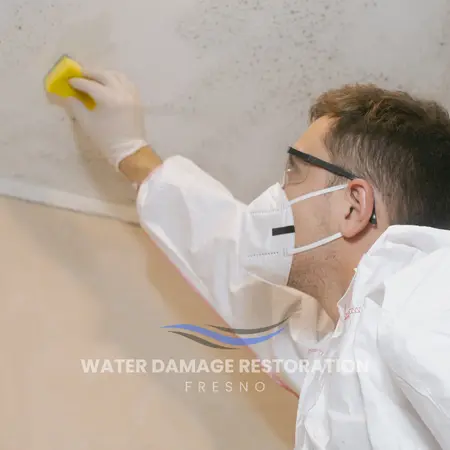
Mold remediation and testing covers two connected but separate steps: confirming whether mold is present and how far it has spread, then physically removing it and addressing the moisture source behind it. Fresno property owners often search for mold testing near me after a slow leak, a flood, or a plumbing failure leaves damp materials sitting too long in the Central Valley heat. Once mold is visible, or a musty smell shows up after water damage, professional mold remediation is usually the safer next step than waiting to see what happens.
When Mold Testing Comes Before Remediation
Mold inspection and mold remediation are not the same service. Inspection identifies whether a problem exists and how far it has spread, while remediation is the physical cleanup and removal work. Professional mold testing often uses air sampling, surface sampling, or both to confirm the presence of mold spores in areas where growth isn't visible yet.
This matters most after water damage, when moisture may have reached wall cavities, subfloor, or insulation that looks dry on the surface. Testing gives a clearer starting point than guessing based on smell or a small visible patch, so remediation work can target the actual affected areas instead of just the obvious ones.
What the Mold Cleanup Process Involves
A typical mold cleanup process starts with containment barriers to keep spores from spreading into unaffected rooms, paired with negative air pressure to pull contaminated air out rather than let it drift. Technicians working inside containment wear PPE equipment appropriate to the contamination level, following practices consistent with the IICRC S520 standard for mold remediation.
From there, HEPA air scrubbers and HEPA vacuums are used to capture spores and fine particles that ordinary cleaning tools would just stir up. For black mold removal or mold removal after water damage, moisture meters and thermal imaging cameras help locate hidden damp areas behind walls or under flooring before those spots are opened up and treated. Once materials are cleaned and dried, antimicrobial encapsulants are typically applied to treated surfaces as part of the finishing steps.
Why Untreated Moisture Leads to Repeat Mold Problems
Mold needs moisture to keep growing, so if damp framing, subfloor, or insulation behind a wall gets missed, the problem often comes back even after visible mold is cleaned up. This is one reason the mold cleanup process relies on moisture meters to confirm a space has actually dried out before it gets closed back up, rather than assuming it based on how a room looks or smells. Fresno's mix of older homes and newer construction means moisture can hide differently depending on how a property was built.
Cost, Timeline, and Insurance Questions Homeowners Ask
Mold remediation cost varies a lot depending on how much area is contaminated, what materials are affected (drywall, insulation, flooring, subfloor), and whether containment needs to isolate multiple rooms. As a general estimate range, smaller isolated jobs often run lower, while larger contamination spanning multiple rooms or requiring extensive material removal costs more — actual pricing depends on scope and access to the affected space.
Timeline works similarly. A small, contained area may wrap up faster than a job involving hidden moisture behind walls or under flooring that needs to be opened up and dried before remediation can finish. On insurance, whether mold is covered by insurance depends on the specific policy and what caused the water intrusion in the first place — a sudden pipe burst is often treated differently than a long-term slow leak. Checking directly with the insurance provider is the most reliable way to know what's covered.
How much does mold removal cost?
Cost depends on the size of the affected area and which materials are involved — drywall, flooring, and insulation each affect labor and disposal differently. As a wide general range, simple jobs often start lower while larger or hidden-moisture cases run higher. A professional assessment gives a clearer, project-specific picture.
Is mold covered by insurance?
Coverage depends on the individual policy and what caused the moisture in the first place, such as a sudden pipe failure versus a long-term leak. It's best to check directly with the insurance provider to understand what a specific policy covers before assuming either way.
Call Our Fresno Team for Mold Remediation and Testing
If you're dealing with visible mold, a musty odor, or damp materials after a leak or flood anywhere in the Fresno service area, our team is available for assessment and remediation guidance. Call +1-855-636-7880 to talk through what you're seeing and get next steps for testing or cleanup.
For related concerns, we also handle emergency water damage restoration, specialized drying and content restoration, and burst pipe and slab leak response when moisture problems start from a plumbing failure. If flooding or storm water is the source of the moisture, our flood damage and storm recovery page covers that process, and sewage-related contamination is addressed separately on our sewage cleanup and decontamination page. You can also visit our homepage for an overview of all restoration services we offer.